Industrial dust collection systems are essential components of modern manufacturing facilities, processing plants, workshops, and industrial production environments. These systems are designed to capture airborne dust, fine particles, and other contaminants generated during industrial operations. Processes such as grinding, cutting, sanding, welding, mixing, and material handling can release particles into the surrounding air. Effective dust collection helps control these emissions and supports cleaner working conditions.
An industrial dust collection system generally uses a combination of extraction hoods, ductwork, filtration equipment, fans, and dust storage units to remove airborne particles from the workplace. The system design depends on the type of dust, particle size, production volume, operating temperature, and required air filtration efficiency. Understanding industrial dust collection technology helps facility managers and engineers evaluate suitable equipment for manufacturing operations, industrial air quality management, and environmental compliance.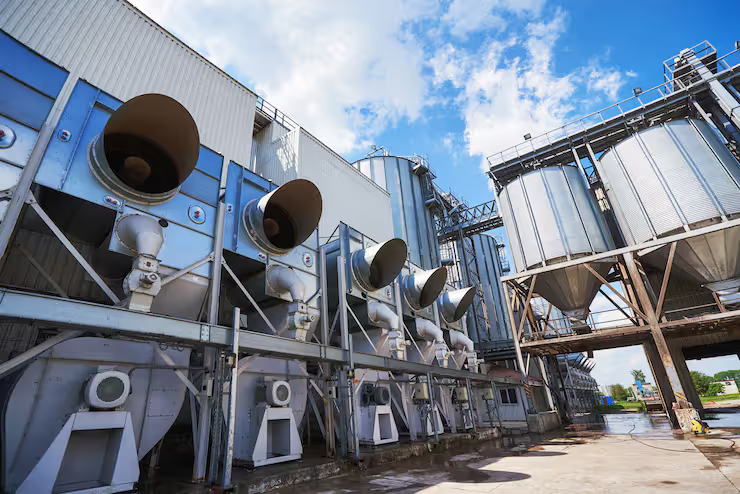
Importance of Industrial Dust Collection Systems
Workplace Air Quality and Environmental Control
Airborne dust can affect indoor air quality, accumulate on machinery, interfere with production processes, and create housekeeping challenges. Industrial air filtration systems help capture particles before they spread throughout a facility. Depending on the application, collected dust may include wood particles, metal fines, mineral dust, plastic fragments, or powder generated during chemical processing.
Dust collection also contributes to environmental management by reducing particulate emissions from industrial operations. However, the level of environmental protection depends on equipment design, filter performance, installation quality, and maintenance practices. Facilities must assess their specific emission requirements and applicable environmental regulations when selecting an industrial dust control system.
Equipment Protection and Production Efficiency
Dust accumulation can affect motors, electrical enclosures, sensors, bearings, and other sensitive machine components. In some production environments, excessive airborne particles can also influence product quality, especially in electronics manufacturing, pharmaceutical processing, food production, and precision engineering.
A properly designed dust extraction system helps control these issues by capturing particles near their source. Maintaining suitable airflow and filtration performance can support consistent production conditions and reduce dust-related maintenance problems. The actual results depend on the nature of the operation and how effectively the collection system is integrated into the production process.
Types of Industrial Dust Collection Systems
Baghouse Dust Collectors
Baghouse dust collectors use fabric filter bags to separate dust particles from an incoming air stream. Dust-laden air passes through the filter media, while particles accumulate on the surface or within the fabric. Cleaned air then exits through the designated outlet. Many industrial baghouse systems use pulse-jet, shaker, or reverse-air cleaning mechanisms to remove accumulated dust from the filters.
These systems are commonly used in cement manufacturing, metal processing, mineral handling, grain processing, and other applications involving substantial dust volumes. Baghouse filtration can provide effective particulate control when the filter media, airflow, temperature limits, and dust characteristics are properly matched to the application.
Cartridge Dust Collectors
Cartridge dust collectors use compact cylindrical filter elements to capture fine airborne particles. Their filter design provides a relatively large filtration area within a compact equipment footprint. Depending on the configuration, cartridge filters may use pleated media and automated cleaning systems to maintain airflow as dust accumulates.
Industrial facilities often use cartridge dust collection equipment for metal fabrication, welding fumes, powder processing, and certain surface-finishing operations. The appropriate filter media depends on particle characteristics, humidity, temperature, and chemical compatibility. Specialized applications may require additional filtration stages or other air treatment technologies.
Cyclone Dust Collectors
Cyclone dust collectors separate particles from air by creating a rotating flow inside a cylindrical or conical chamber. Centrifugal forces move heavier particles toward the outer wall, allowing them to fall into a collection hopper. The remaining air exits through the outlet.
Cyclone systems are frequently used in woodworking, grain handling, mineral processing, and industrial material conveying. They are particularly useful for removing larger or heavier particles before air reaches a secondary filtration unit. However, cyclone efficiency varies with particle size, airflow, and equipment geometry, so fine-particle applications may require additional filtration.
Wet Scrubbers
Wet scrubbers use a liquid, commonly water or a formulated scrubbing solution, to capture particles from an industrial gas stream. Contact between the liquid and contaminated air allows particles to become trapped in droplets or liquid films. Some scrubbers are designed for applications where dust characteristics or process conditions make dry filtration less suitable.
Wet dust collection can be used in selected chemical processing, metalworking, and mineral-processing operations. System design must account for wastewater management, corrosion resistance, liquid circulation, and the properties of the collected material. Wet scrubbers are not universally suitable for every dust type, and their operating requirements differ from those of dry filtration equipment.
Portable and Centralized Dust Collection Systems
Portable dust collectors are designed to serve individual machines, workstations, or temporary industrial activities. Their mobility makes them useful in smaller workshops, maintenance areas, and facilities where production layouts change frequently.
Centralized dust collection systems connect multiple extraction points to a shared filtration unit through an engineered duct network. These systems are commonly used in large manufacturing plants with several dust-generating machines. Their performance depends on duct sizing, airflow balancing, extraction-point design, and the simultaneous operating requirements of connected equipment.
Key Components of an Industrial Dust Collection System
Dust Capture Hoods and Extraction Points
Capture hoods collect dust as it is generated by a process. They may be positioned around cutting tools, grinding stations, mixing equipment, transfer points, or enclosed production machinery. Hood design and placement are important because particles can disperse rapidly if the extraction point is too far from the source.
Effective source capture considers particle movement, machine geometry, operator access, and the direction of process airflow. Enclosures and local exhaust ventilation can improve capture performance when designed for the specific operation.
Ductwork and Airflow Management
Ductwork transports contaminated air from the extraction points to the filtration equipment. Duct diameter, length, bends, branches, and airflow velocity influence system performance. Poorly designed duct networks can cause particle deposits, uneven extraction, pressure losses, and excessive energy consumption.
Industrial ventilation design therefore requires appropriate airflow calculations and consideration of the dust's physical properties. Systems handling combustible dust may also require specially engineered duct arrangements and protective measures under applicable standards.
Industrial Fans and Blowers
Fans and blowers provide the pressure and airflow required to move contaminated air through the collection network. Their selection depends on the required airflow, total system resistance, filter pressure drop, and operating conditions.
The fan must be compatible with the complete system rather than selected solely by motor power. Proper sizing can help maintain effective extraction while avoiding unnecessary energy use. Variable-frequency drives may be appropriate in some systems where airflow requirements change during production.
Filtration Media and Filter Cleaning
Filter media are responsible for separating airborne particles from the air stream. Common materials include polyester, cellulose blends, specialty synthetic media, and application-specific high-temperature or chemically resistant fabrics. Filter selection depends on particle size, moisture, temperature, chemical exposure, and the required collection performance.
Many industrial dust collectors use pulse-jet cleaning, which releases short bursts of compressed air to dislodge accumulated dust. Other systems use mechanical shaking or reverse-air cleaning. Routine inspection of filters, seals, cleaning mechanisms, and differential pressure helps identify conditions that can reduce filtration performance.
Dust Hoppers and Collection Containers
Collected particles typically fall into a hopper or storage container beneath the filtration chamber. Depending on the equipment design, dust may be removed manually or through rotary valves, screw conveyors, sealed bins, or other discharge arrangements.
Dust handling requires attention to material characteristics and containment. Some powders can become airborne again during emptying, while certain combustible or chemically reactive dusts require specialized collection and disposal procedures. Collection containers must be appropriate for the material and the operating environment.
Monitoring and Control Systems
Modern dust collection systems may include differential-pressure sensors, airflow indicators, motor controls, filter-cleaning controllers, and automated alarms. These components help operators monitor the condition of the equipment and identify possible blockages, filter loading, or changes in system performance.
More advanced installations may connect monitoring equipment to industrial control systems for operational reporting and maintenance planning. Monitoring does not replace physical inspection, but it can provide useful information about changing operating conditions.
Industrial Applications of Dust Collection Systems
Metal Fabrication and Welding
Metal fabrication facilities generate dust and particulate matter during grinding, cutting, polishing, and finishing operations. Welding processes can also produce fumes containing fine particles and process-specific contaminants. Industrial extraction equipment helps capture these emissions near the source.
The required technology depends on the operation. General metal dust collection may use cartridge or baghouse systems, while welding fume control often requires purpose-designed local exhaust ventilation and filtration. Material composition and the possibility of combustible metal dust must be evaluated before equipment is selected.
Cement and Construction Material Manufacturing
Cement plants, concrete batching facilities, and construction material manufacturers generate dust during crushing, grinding, mixing, conveying, and packaging. Baghouse dust collectors and cartridge filtration systems are used in suitable applications to control particulate emissions.
Transfer points, silos, mixers, and packaging lines often require dedicated extraction arrangements. Equipment selection must consider dust loading, abrasive particles, temperature, operating hours, and environmental requirements. Effective maintenance is especially important where fine mineral dust can accumulate throughout the production area.
Woodworking and Furniture Manufacturing
Woodworking operations produce sawdust and fine wood particles during sawing, sanding, routing, and shaping. Dust extraction systems can connect directly to individual machines or use centralized duct networks serving several workstations.
Cyclone separators may remove larger wood particles before secondary filtration, while baghouse or cartridge units capture finer dust. Wood dust can present a fire and explosion hazard under certain conditions, so system design must consider combustible-dust risks, housekeeping, and applicable safety requirements.
Pharmaceutical and Chemical Processing
Pharmaceutical and chemical facilities may generate powders during blending, granulation, milling, weighing, and material transfer. Dust collection in these environments requires careful consideration of product containment, worker exposure, cross-contamination, and the chemical properties of the material.
Suitable systems may incorporate high-efficiency filtration, enclosed transfer arrangements, specialized filter-change procedures, or other containment features. Some pharmaceutical operations require validated cleaning practices and specific hygienic design considerations. The appropriate configuration depends on the material, process, and regulatory framework.
Food Processing and Agriculture
Food manufacturing and agricultural operations can release flour dust, grain particles, starch, sugar, and other powdered materials. Dust collection systems help control airborne particles around conveying, milling, mixing, storage, and packaging equipment.
Food-processing applications may require hygienic construction, suitable filter materials, and cleaning procedures that limit contamination. Organic dusts can also be combustible, so facilities must assess dust explosion hazards and select equipment designed for the identified risks.
Electronics and Precision Manufacturing
Electronics manufacturing and precision engineering may require effective control of fine particles around sensitive production equipment. Dust can interfere with surface preparation, component assembly, optical inspection, and other processes where contamination affects product quality.
Dust collection may be combined with local exhaust ventilation, cleanroom filtration, or specialized process extraction. These technologies perform different functions, and their selection should reflect the required cleanliness level, particle characteristics, and production process.
How to Select an Industrial Dust Collection System
Evaluate Dust Characteristics
The first step is to understand the material being collected. Particle size, density, abrasiveness, moisture content, temperature, and chemical properties influence the type of collector and filtration media required. Combustibility and toxicity must also be evaluated because they can affect equipment design, containment, and protective measures.
Determine Airflow and Filtration Requirements
System capacity depends on the number of extraction points, the capture requirements of each process, the duct layout, and whether several machines operate simultaneously. Engineers assess airflow, static pressure, filter loading, and the required particulate control performance before determining equipment specifications.
Filtration efficiency should be evaluated alongside the entire installation. A high-performance filter cannot compensate for poor source capture, leaking ducts, or inadequate airflow.
Consider Energy Consumption and Maintenance
Industrial dust collectors use energy to operate fans, compressed-air cleaning systems, and other supporting equipment. Filter pressure drop, fan efficiency, operating schedules, and airflow control can influence overall energy consumption.
Maintenance planning should account for filter inspection, dust removal, duct cleaning, fan servicing, and replacement of worn components. Systems that are accessible for inspection and routine maintenance can be easier to manage over their operating life.
Assess Safety and Regulatory Requirements
Facilities should identify applicable occupational health, environmental, fire protection, and combustible-dust requirements before installation. Depending on the jurisdiction and process, relevant guidance may include local environmental rules, workplace exposure requirements, and standards addressing industrial ventilation or combustible dust hazards.
Dust collectors handling combustible materials may require explosion venting, suppression, isolation, bonding, grounding, or other engineered protection. These measures depend on a formal hazard assessment and the applicable design standards. General-purpose equipment should not be assumed suitable for combustible or hazardous dust.
Maintenance Best Practices for Dust Collection Equipment
Routine Inspection and Filter Monitoring
Regular inspections help identify damaged filters, loose connections, leaks, abnormal vibration, and changes in airflow. Differential-pressure readings can indicate filter loading or other operating changes, although the readings must be interpreted in the context of the specific equipment.
Maintenance schedules should follow the manufacturer's instructions and account for dust characteristics, production intensity, and operating conditions. Records of inspections and repairs can help identify recurring problems and support preventive maintenance planning.
Duct Cleaning and Dust Disposal
Ductwork and collection hoppers should be checked for excessive deposits, blockages, and leakage. Accumulated dust can restrict airflow and may create additional hazards, especially when the material is combustible or reactive.
Collected material should be handled according to its properties and applicable disposal requirements. Facilities should avoid cleaning methods that unnecessarily disperse fine particles into the air. Special precautions may be necessary for hazardous powders, metal dusts, and combustible materials.
Performance Testing and System Improvements
Periodic performance assessments can help determine whether the system continues to meet its intended extraction and filtration requirements. Testing may include airflow measurements, inspection of capture points, filter-condition checks, and evaluation of emissions where required.
Changes to production machinery or the addition of extraction branches can alter airflow throughout a centralized network. System performance should therefore be reassessed after significant modifications rather than assuming the original design remains adequate.
Emerging Trends in Industrial Dust Collection Technology
Automated Monitoring and Predictive Maintenance
Industrial dust collection equipment increasingly incorporates sensors and digital controls to monitor pressure drop, airflow, equipment status, and maintenance indicators. These measurements can help maintenance teams recognize developing problems and schedule inspections based on operating conditions.
Predictive maintenance depends on reliable measurements and appropriate interpretation. Sensors can support maintenance decisions, but they do not independently confirm that a system meets all safety or emissions requirements.
Energy-Efficient Filtration Systems
Energy efficiency is an important consideration for facilities operating dust collection equipment for long production shifts. Improved fan designs, suitable filter media, optimized ductwork, and demand-based airflow control may help reduce unnecessary energy consumption.
The potential benefit depends on the existing installation, process requirements, and operating pattern. Any energy-saving adjustment must preserve adequate capture velocity, filtration performance, and required safety functions.
Integrated Industrial Air Quality Management
Dust collection is increasingly considered as part of a wider industrial air quality strategy that includes source reduction, local exhaust ventilation, general ventilation, monitoring, and workplace housekeeping. Integrating these elements can help facilities manage airborne contaminants more consistently.
The appropriate approach differs by industry and process. A manufacturing facility handling fine chemical powders may require different controls from a woodworking workshop or cement plant, even when all three use industrial dust collection equipment.
Conclusion
Industrial dust collection systems play an important role in controlling airborne particles across manufacturing, metal fabrication, construction materials, woodworking, food processing, chemical production, and other industrial sectors. Common technologies include baghouse collectors, cartridge collectors, cyclones, wet scrubbers, and portable or centralized extraction systems.
Selecting suitable equipment requires an understanding of dust characteristics, airflow requirements, filtration media, maintenance needs, energy consumption, and applicable safety regulations. Regular inspection and performance monitoring help maintain effective operation as production conditions change. By integrating appropriate dust capture, filtration, and dust handling practices, industrial facilities can support cleaner work environments, protect equipment, and manage particulate emissions more effectively.